
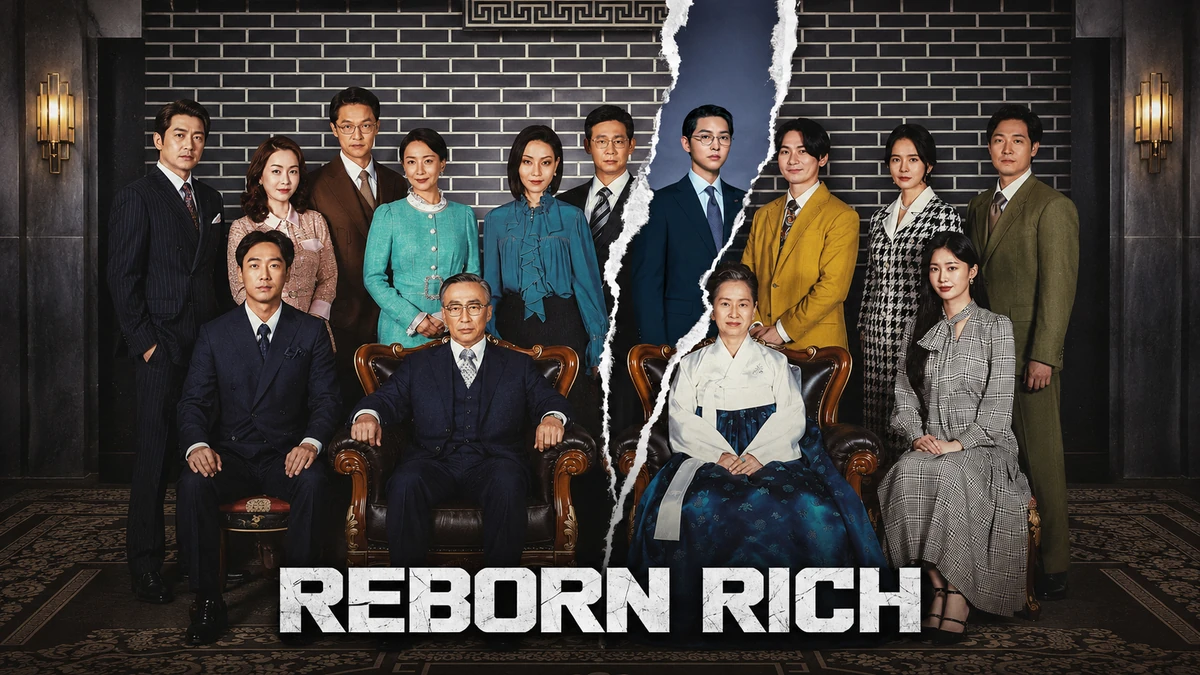
If we could live our lives again, would we also be able to change the mistakes we made in the past?
The final episode of this drama raises an unexpected question for viewers who have followed the intense succession battle within a powerful conglomerate family.
Reborn Rich concluded with its 16th episode on December 25, 2022. In the finale, the most important question is no longer who will take control of the Soonyang Group, but who will finally accept responsibility for the past.
From this point forward, this article contains major spoilers about the final episode and its biggest revelations.

Why Did Jin Do-jun’s Story End With a Car Accident?
Toward the end of Episode 15, Jin Do-jun is involved in a car accident after making considerable progress toward gaining control of the Soonyang Group.
Because he has repeatedly used his knowledge of the future to overcome difficult situations, the sudden accident comes as an even greater shock.
Do-jun already knows the history and corporate developments that will shape the years ahead.
However, knowing the future is not the same as being able to avoid every danger that lies ahead.
The final episode confirms that Do-jun dies in the accident.
His death demonstrates that even someone approaching extraordinary success cannot completely control the ambitions and criminal actions of others.
Earlier in Reborn Rich, both Jin Yang-cheol and Do-jun faced a life-threatening car accident.
The repeated use of vehicle accidents emphasizes that the struggle for power within the Soonyang family is far more dangerous than a simple conflict over business decisions.
It is a competition in which people’s lives can become targets.
However, the repeated accidents do not necessarily prove that everything is controlled by an unchangeable destiny.
What matters most in the ending is not the rules of fate, but who was responsible for causing the accident.
What Changed When Yoon Hyun-woo Returned to Reality?
After Do-jun’s death, the story returns to Yoon Hyun-woo’s original life.
Hyun-woo, who had been shot overseas, is rescued with the help of prosecutor Seo Min-young and eventually regains consciousness in a hospital.
For Hyun-woo, the many years he spent living as Do-jun remain vivid and real.
However, only about a week has passed in his original reality since the shooting.
The enormous difference between the 17 years he experienced and the short period that passed in reality leaves him deeply confused.
One important fact is that the story does not end with Yoon Hyun-woo continuing to live permanently as Jin Do-jun.
Instead, he must return to the society he originally belonged to and confront the reality of the Soonyang Group once again.
To make matters worse, the company does not protect him.
Instead, Hyun-woo is accused of embezzling a massive amount of money from its secret funds.
The organization he once served with absolute loyalty again demonstrates how easily it can abandon an employee when doing so benefits those in power.
Hyun-woo still possesses the judgment and experience he gained while living as Do-jun.
But he no longer has the privileged status of a grandson within a wealthy family.
His final struggle must therefore be fought not through knowledge of the future or inherited power, but through evidence and cooperation with others.
The Shocking Revelation About Hyun-woo’s Involvement in Do-jun’s Death
The finale’s biggest revelation is that the connection between the two men goes far beyond their stories being portrayed by the same actor.
Approximately 20 years earlier, a young Yoon Hyun-woo followed instructions from his superior, Kim Joo-ryeon.
He positioned a truck in front of Do-jun’s vehicle, blocking its path.
At the time, Hyun-woo carried out the assignment without fully understanding the criminal plan in which he had become involved.
Another large truck then crashed into Do-jun’s vehicle, and Hyun-woo witnessed the accident firsthand.
Afterward, his superior demanded that he remain silent.
Hyun-woo initially considered reporting what had happened.
Ultimately, however, he chose not to speak.
He was afraid of losing the opportunity to join Soonyang and build an ordinary career.
This revelation does not mean Hyun-woo personally planned Do-jun’s murder.
Rather, it establishes that even without knowing the entire plan, he was present at the scene and became involved in concealing the crime.
His attitude toward Soonyang in his original life was therefore not something that appeared suddenly.
Years earlier, he had already chosen to ignore the truth to protect his own future.
That decision helped shape him into someone who would continue serving the company without questioning its demands.
Living as Do-jun becomes an experience in which Hyun-woo is forced to confront the life of the very person whose death he once helped conceal.
In this sense, the connection between their two lives carries far greater emotional weight than an ordinary plot twist.
Who Actually Ordered Jin Do-jun’s Murder?
The final episode reveals that Jin Young-ki, Jin Yang-cheol’s eldest son, was responsible for ordering the car accident that killed Do-jun.
A recording of a phone conversation from the time becomes crucial evidence during the final hearing.
Earlier suspicions had pointed toward Jin Seong-jun’s possible involvement in Do-jun’s death.
However, the final revelation identifies his father, Young-ki, as the person behind the crime.
Young-ki also uses the suspicion surrounding his son to strengthen his own claim to corporate power.
What appears to be a father’s attempt to protect his family is ultimately connected to his ambition to control the company.
It is important to distinguish between two separate crimes.
Young-ki is responsible for ordering Do-jun’s death in the past.
Meanwhile, Jin Seong-jun is behind the attempt to eliminate Yoon Hyun-woo in the present.
These crimes, committed across two generations, reveal how similar methods of protecting power have continued within the Soonyang family.
Just as corporate control passes from parents to children, the willingness to sacrifice subordinates and avoid responsibility is also repeated.
The Meaning of the Recording Revealed at the Hearing
Hyun-woo joins forces with prosecutor Seo Min-young and Oh Se-hyun to expose the illegal succession practices of the Soonyang family.
Oh Se-hyun gathers support from minority shareholders, while Min-young uses legal procedures to investigate the truth.
However, the beginning of the hearing does not immediately guarantee that justice will be served.
Soonyang’s representatives attempt to redirect the proceedings in their favor, weakening Hyun-woo’s accusations.
At this critical moment, Hyun-woo reveals the recording of a phone conversation connected to the accident 20 years earlier.
The recording, containing Young-ki’s instructions, exposes the truth behind Jin Do-jun’s death.
Even more importantly, Hyun-woo admits that he himself was involved in the incident.
Rather than placing every part of the blame on the wealthy family, he publicly acknowledges his own wrongdoing.
The precise extent of his legal responsibility is a separate question.
Nevertheless, within the story, his confession represents a fundamental change.
He is no longer the man who unquestioningly follows orders from powerful people.
It is also significant that his final counterattack does not involve secret investments or corporate acquisitions.
Instead, he chooses to reveal the truth through public testimony.
While Do-jun challenged Soonyang through wealth and share ownership, Hyun-woo attacks the foundation of its power by exposing the crimes that helped sustain it.
Who Ultimately Takes Control of the Soonyang Group?
Following the hearing, the Soonyang family withdraws from management.
The corporation moves away from family-controlled leadership and transitions toward a professional management system.
This should not be interpreted as Yoon Hyun-woo becoming the company’s new chairman.
Rather than simply taking the family’s position for himself, he challenges the assumption that the founding family has an unquestionable right to control the business.
This provides a different answer to the struggle for corporate control that defined much of Do-jun’s story.
Replacing one powerful individual with another does not necessarily solve the problems created by unchecked authority.
Of course, introducing professional management does not automatically eliminate every problem within a corporation.
However, the drama presents a management structure based on accountability rather than family lineage as its final major change.
Hyun-woo’s revenge therefore moves beyond taking someone else’s position.
It becomes an effort to expose and challenge the corrupt practices that allowed that position to exist.
Were the 17 Years as Jin Do-jun Just a Dream?
One of the most debated questions surrounding the ending of Reborn Rich is whether Hyun-woo’s experiences as Do-jun actually happened.
When Hyun-woo wakes up in the hospital, many viewers interpret the entire period as a dream.
Only about a week has passed in his original reality, and Do-jun remains someone who died in the past.
From this perspective, the 17 years could be understood as an extended dream or experience during Hyun-woo’s unconscious state.
However, this explanation does not fully account for every detail.
When Hyun-woo uses an expression associated with Do-jun while speaking to Oh Se-hyun, Oh reacts with surprise at the familiar words.
The moment suggests a connection between the memories of the two lives.
A conversation with Seo Min-young near the ending also contains details that recall Do-jun’s past.
By including these moments, the drama avoids establishing one definitive scientific explanation for what happened.
Therefore, it would be premature to conclude that everything was unquestionably real time travel or that the entire experience was nothing more than a meaningless dream.
What the story clearly establishes is that Hyun-woo returns with memories of living as Do-jun.
Those memories fundamentally change the decisions he makes in the present.
The drama appears less interested in explaining the supernatural mechanism than in exploring the consequences of the experience.
What Does the Final Monologue Mean by Repentance?
Near the end, Hyun-woo interprets his extraordinary experience not as possession or time travel, but as repentance.
This statement is better understood as his personal interpretation of what happened rather than scientific proof that time travel never occurred.
In his previous life, Hyun-woo believed that obeying powerful people was necessary for survival.
However, after experiencing life from Do-jun’s perspective, he understands the human consequences of the incident he once ignored.
What had once been little more than a line in an accident report becomes the destruction of an entire person’s future.
For the victim, it meant losing the opportunity to pursue dreams, maintain relationships, and continue living.
Hyun-woo cannot undo Do-jun’s death.
But he can refuse to repeat the silence that helped conceal it.
Repentance is not the ability to erase the past. It is the willingness to acknowledge what happened and make a different choice in the present.
From this perspective, the central message of the ending is responsibility rather than perfect revenge.
Hyun-woo cannot complete the life that Do-jun lost.
However, he can make sure that Do-jun’s death is no longer hidden without accountability.
Was the Second Chance Really About Changing the Past?
While living as Do-jun, Hyun-woo could anticipate future events and make decisions based on what he knew.
He could invest before an economic crisis, recognize business opportunities, and respond to the actions of family members before their plans fully developed.
However, when he returns to his original reality, Do-jun’s death remains unchanged.
This creates a striking contrast with the time-travel abilities that shaped the earlier episodes.
Erasing the consequences of the past and accepting responsibility for past wrongdoing are two very different things.
During the final hearing, Hyun-woo’s best option is not to turn back time.
Instead, he must reveal the truth and challenge the system that allowed powerful individuals to conceal their crimes.
His decision cannot bring Do-jun back to life.
But it ensures that Do-jun’s death will not remain an incident for which nobody is held accountable.
This is why the second chance presented in the finale has a meaning beyond wealth, status, or a new identity.
It represents an opportunity to stop ignoring wrongdoing.
Jin Yang-cheol’s Legacy and the Question of Inheritance
During his lifetime, Jin Yang-cheol placed enormous importance on the future of the Soonyang Group.
Having built the company himself, he valued business judgment, determination, and the ability to recognize opportunities.
His interest in Do-jun was therefore connected to more than their family relationship.
He recognized the younger man’s understanding of business.
However, after Yang-cheol’s death, the family’s succession struggle becomes increasingly ruthless.
Despite the founder’s desire for his company to survive and prosper, his descendants become consumed by their efforts to protect their own positions.
Their competition eventually leads to betrayal and crime.
This raises an important question:
Does simply belonging to the founding family make someone qualified to inherit control of a corporation?
Do-jun spends much of his story attempting to gain control of Soonyang.
Yet he never achieves that ambition.
Hyun-woo, by contrast, helps bring an end to the family’s control without attempting to claim the chairman’s position himself.
The contrast suggests that inheriting wealth and continuing a legacy of responsible leadership are not necessarily the same thing.
Why Are Seo Min-young and Oh Se-hyun Important to the Ending?
Seo Min-young helps rescue Hyun-woo and participates in uncovering Soonyang’s illegal succession practices.
Oh Se-hyun, who still remembers his relationship with Do-jun, joins Hyun-woo in taking action against the powerful family.
These characters matter because Hyun-woo cannot change Soonyang’s system alone.
When he lived as Do-jun, he possessed enormous financial resources and access to investment opportunities.
As an ordinary employee again, he needs people willing to examine the evidence, expose wrongdoing, and act alongside him.
Their cooperation demonstrates that meaningful change does not always require personal wealth or inherited influence.
Min-young’s role also adds an important emotional dimension.
She is not portrayed as someone who remembers both of Hyun-woo’s lives.
Hyun-woo alone carries the memories of those two experiences, while the two characters encounter each other again under different circumstances.
The subtle sense of familiarity in their final interactions should therefore not be treated as definite proof that their previous relationship has been restored.
Instead, it leaves a lingering impression that certain memories and emotions continue to influence the present.
Why the Drama’s Ending Is Different From the Original Novel
In the original web novel, Do-jun’s life continues, and he eventually becomes chairman of the Soonyang Group.
The television adaptation takes a very different direction.
After Do-jun’s death, the story returns to Yoon Hyun-woo’s reality and concludes with his confession and changes to the company’s management structure.
This difference generated considerable debate among viewers.
For audiences who had spent many episodes watching Do-jun use his knowledge of the future to build his position, his sudden death could feel deeply disappointing.
His achievements had been central to the story, making the shift back to Hyun-woo’s original life especially surprising.
On the other hand, the ending can also be interpreted as a deliberate decision to emphasize responsibility over personal wealth and success.
Both reactions are understandable.
For much of its story, Reborn Rich strongly emphasizes the satisfaction of a protagonist rising through society with extraordinary advantages.
Yet its ending turns toward questions of guilt, accountability, and social responsibility.
This contrast explains why the final episode produces such different responses.
It is also useful to distinguish between the intended message of an ending and how convincingly that message is delivered.
Even if the theme of repentance is clear, viewers may still feel disappointed by the abrupt conclusion to the character they had supported for so long.
The debate itself reveals the difference between what the drama encouraged its audience to expect and what it ultimately chose to deliver.
What Did the Ending Really Bring to a Close?
The ending of Reborn Rich is not ultimately about returning to the past and correcting every mistake.
It is better understood as a story about acknowledging irreversible wrongdoing and ending a cycle of silence.
Jin Do-jun is dead, and the future he worked toward does not unfold exactly as he hoped.
Yoon Hyun-woo is also not entirely free from responsibility for the events of the past.
However, the man who once helped conceal the accident finally chooses to reveal the truth publicly.
Someone who previously sacrificed his own judgment to serve an organization begins making decisions according to his conscience.
Most importantly, the story challenges the belief that control of Soonyang belongs naturally and permanently to one family.
This connects Do-jun’s death and Hyun-woo’s return into a single narrative about power and responsibility.
The drama never provides a completely definitive explanation of how the extraordinary experience became possible.
Instead, the final episode emphasizes a different idea.
What matters more than receiving another chance to live in the past is the choice we make in the present.
Viewers may continue to disagree about whether the ending was satisfying.
Nevertheless, its central message remains clear.
After experiencing two very different lives, a man who once remained silent finally confronts his own responsibility and chooses to reveal the truth.
That decision, rather than the possession of wealth or corporate power, becomes the lasting meaning of his second chance.