
What would you think if you saw a job advertisement offering an hourly wage dozens of times higher than usual? At first, it might seem like an incredible opportunity. But sooner or later, you would probably start wondering what the catch was.
Netflix’s Dead-End Job begins with exactly that kind of hesitation. When a young man desperate for money accepts a suspicious offer, an ordinary workplace turns into something he could never have imagined.
The unusual premise immediately caught my attention. But as the story continued, I found myself thinking about the main character’s circumstances just as much as the frightening situations he faced. His struggle between wanting to escape and needing to earn money felt surprisingly believable. The familiar joke that rent and debt can be scarier than ghosts suddenly didn’t seem so funny.
Released on Netflix on October 30, 2026, this eight-episode mystery, horror, and fantasy series currently has one season. Directed by Kim Da-min, it stars Lee Jae-wook, Go Min-si, Kim Min-ha, and Lee Hee-joon. The story centers on Byeon Hyeok-jun, a young man overwhelmed by debt, and a mysterious employment agency called Geomi Manpower.

The Strange Conditions Behind an Unbelievably High Hourly Wage
Byeon Hyeok-jun is struggling to get through each day because of debts he cannot easily repay. One day, he comes across a job advertisement promising 50 times the minimum hourly wage. The money sounds too good to refuse, but something about the jobs he is offered feels deeply suspicious.
There is also one unusual condition: he must never tell anyone outside the workplace what happens during his shifts.
The owner of Geomi Manpower recommends these jobs as though they are nothing out of the ordinary. The contrast between his calm explanations and the enormous pay creates an unsettling feeling. Watching Hyeok-jun hesitate, even though he knows something is wrong, makes it seem as if the horror has already begun before he even starts working.
What makes the premise particularly interesting is that the story does not begin inside a secret laboratory or on some distant planet.
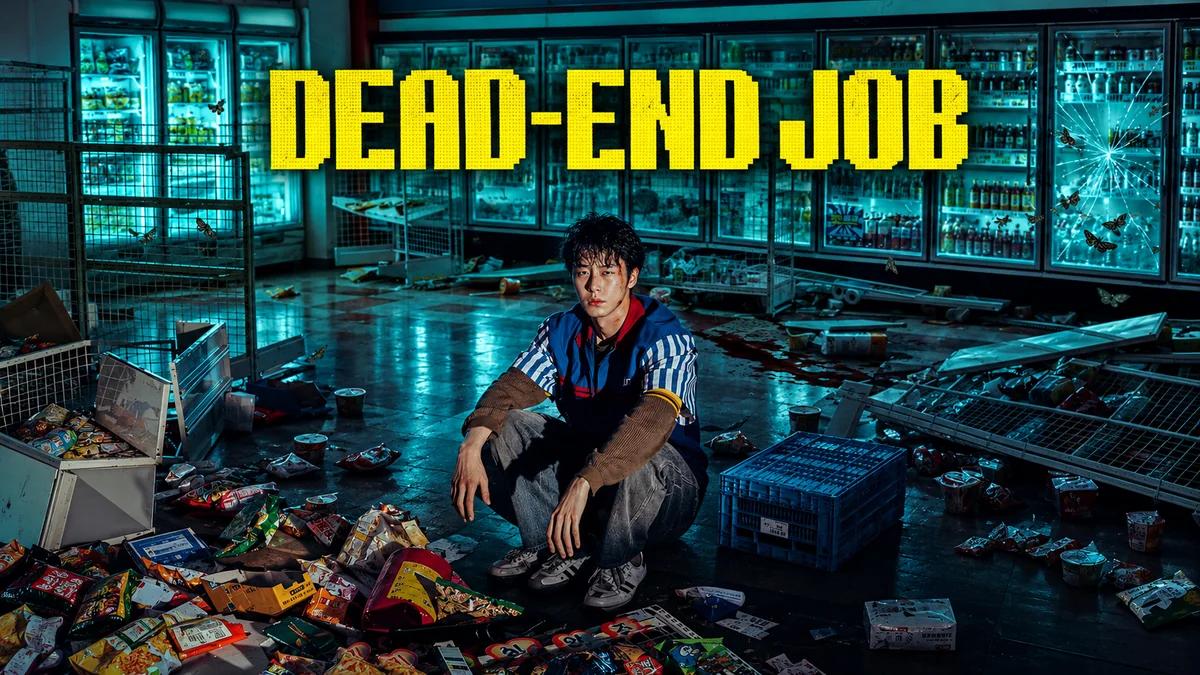
The first workplace is a convenience store, the kind of place almost everyone has visited. A familiar setting where employees greet customers and organize products suddenly becomes terrifying because of a few strange rules.
The show’s ability to turn an ordinary location into something unfamiliar and frightening is clear from the very first episode.
A Different Nightmare at Every Workplace
One of the most entertaining aspects of Dead-End Job is how each episode introduces a different workplace and a new kind of horror.
The story begins with a night shift at a convenience store before moving on to unusual jobs involving a clown, milk deliveries, a movie theater, clinical trials, a construction site, and an amusement park.
Although we continue following the same main character, each new assignment feels almost like watching a separate supernatural story.
The convenience store episode is especially memorable because it creates tension through atmosphere rather than lengthy explanations.
The brightly lit store, ordinary shelves, and strange behavior of unfamiliar coworkers gradually begin to feel wrong.
Because the location is so familiar, the fear becomes even more effective. It captures the kind of everyday horror that might briefly cross your mind the next time you enter a convenience store late at night.
The milk delivery story offers a different experience.
Strict time limits and unfamiliar buildings create constant pressure, making viewers feel as though they need to hurry along with the characters.
The tension comes not only from wondering what might suddenly appear but also from the anxiety of having to finish the assigned task.
That sense of pressure stayed with me longer than a simple jump scare.
The atmosphere changes again when the story moves to places such as a movie theater or a construction site.
In narrow, quiet locations, even a small sound becomes unsettling. In larger spaces, the fear comes from not knowing where danger might be hiding.
The workplaces themselves almost feel like characters that help drive the story forward.
The Tension Begins the Moment You Read the Rules
The series makes excellent use of the appeal of internet-style “rules horror,” a type of supernatural story built around strange instructions that must be followed.
The characters are given unusual rules, but they are rarely told exactly why those rules exist.
Certain actions are forbidden, and specific situations require them to behave in a particular way.
The missing explanations leave plenty of room for viewers’ imaginations.
What makes these moments especially entertaining is not simply hearing the rules for the first time. It is watching what happens when those rules become difficult to follow.
An instruction that initially sounds simple can suddenly turn into an impossible choice.
As a character hesitates, viewers naturally begin searching for an answer themselves.
Instead of simply watching the horror unfold, it feels as though you are trying to solve the problem alongside the characters.
Some scenes maintain an unsettling atmosphere without clearly revealing the frightening presence.
A sound coming from the end of a hallway, movement behind a closed door, or an ordinary object suddenly taking on a disturbing meaning can be enough to create tension.
Rather than forcing fear through constant shocking images, the show gradually builds suspense by making the rules of everyday life feel unreliable.
Lee Jae-wook’s Clumsy but Determined Fight for Survival
Byeon Hyeok-jun is not the kind of hero who remains calm and confident in every dangerous situation.
When he gets scared, it shows. He panics, makes mistakes, and sometimes reacts in ways that seem almost embarrassingly clumsy.
But that is exactly what makes him likable.
If he faced every supernatural threat without showing any fear, the character would probably feel much less believable.
Lee Jae-wook does an excellent job portraying an ordinary young man caught in extraordinary circumstances.
His exhausted expressions, anxious eyes, and instinctive reactions feel very different from those of a typical action hero.
When he struggles to survive, what stands out is not an extraordinary ability but his determination to somehow make it through another day.
The actor’s performance is a major reason why Dead-End Job feels like more than a collection of frightening encounters.
His physical reactions during dangerous situations are convincing, but so are the quieter emotional changes that appear whenever he thinks about money or his family.
He also moves naturally between comedy and desperation.
A scene can be funny one moment and emotionally intense the next, and Lee makes both sides of the character feel believable.
Kim Min-ha Brings Energy and a Believable Sibling Dynamic
Hyeok-jun’s younger sister, Byeon Ji-yun, has a very different personality from her brother.
While Hyeok-jun tends to worry and becomes frightened easily, Ji-yun is much more willing to act decisively once she has made up her mind.
Whenever they appear together, their contrasting personalities create entertaining exchanges and moments of natural humor.
These familiar sibling arguments are a welcome change of pace in the middle of a horror story.
Kim Min-ha captures Ji-yun’s determined personality through her steady gaze and quick reactions.
Her refusal to back down easily gives many scenes a completely different rhythm.
However, Ji-yun is not simply portrayed as someone who is always strong.
As her own fears become clearer, she begins to feel more human and relatable.
Personally, I found the relationship between the siblings to be one of the warmest parts of the series.
They worry about each other but do not always express their feelings directly.
They argue and complain, yet when something truly matters, they instinctively look out for one another.
Their shared history comes through without the need for long explanations.
The warmth of an ordinary family relationship surviving in the middle of terrifying circumstances adds an emotional layer that I really appreciated.
Go Min-si and Lee Hee-joon Create a Quiet Sense of Dread
Go Min-si plays Eum Yeon-ju, an accident investigator working for the Labor Accident Protection Agency.
Whenever she appears, the atmosphere of the story changes.
She seems to know more than she reveals, yet she rarely makes her true intentions clear.
Her voice and expressions remain calm, but the situations surrounding her often become even more mysterious.
She is the kind of character who becomes more intriguing precisely because she does not explain everything.
When Yeon-ju enters the story, the audience begins to wonder about more than the immediate dangers facing the characters.
Why do these strange workplaces exist? Who understands the risks involved? Is anyone actually trying to stop what is happening?
These questions naturally emerge as the story develops.
Go Min-si’s restrained performance helps maintain that curiosity without revealing too much.
Lee Hee-joon’s portrayal of the Geomi Manpower owner is memorable for a different reason.
He recommends dangerous jobs while behaving like an ordinary employment agent.
His seemingly friendly manner and difficult-to-read expressions create an unsettling combination.
The more he explains, the more cautious you become.
He has a strong presence without needing to raise his voice.
Some of his statements also sound strangely reasonable.
People need to work to earn money. It is such a familiar argument that it can be difficult to challenge.
But when that simple idea is placed inside a terrifying situation, it begins to take on a disturbing meaning.
Watching this character makes it clear that the horror in the series is not limited to supernatural creatures.
The contrasting performances of the main cast give the story several interesting emotional layers.
Finding the Right Balance Between Horror and Dark Comedy
Watching a horror series can become exhausting when the tension never lets up.
Fortunately, this drama gives viewers occasional moments to relax through the characters’ unusual reactions and realistic conversations.
Even in dangerous situations, familiar aspects of everyday working life can be surprisingly funny.
There is something strangely amusing about watching characters approach an obviously suspicious job with the attitude that they only need to survive one more shift.
They calculate their wages or worry about completing their assigned working hours while completely bizarre events unfold around them.
The contrast between ordinary workplace concerns and supernatural danger creates a distinctive sense of humor.
The moments when fear and laughter appear at the same time are what give the series much of its personality.
How Visuals and Sound Transform Familiar Workplaces
One aspect of Kim Da-min’s direction that caught my attention was the way each location creates a different visual atmosphere.
A convenience store illuminated by fluorescent lights, a dark hallway, an unfamiliar building, and an amusement facility all produce different kinds of anxiety.
Rather than simply filling every scene with frightening objects, the series focuses on making familiar environments look subtly wrong.
Bright lighting inside a store would normally make people feel safe.
Here, however, that same brightness can create the uncomfortable impression that there is nowhere to escape.
In quiet scenes, the silence seems to stretch longer than expected.
When something suddenly moves, even a small change can be startling.
The gradual construction of atmosphere feels just as important as the more visually shocking moments.
I also liked how the camera gives characters time to notice something unusual.
Viewers start searching the background for clues before the characters themselves recognize what is happening.
You may find yourself examining the edges of the screen or watching a doorway for the slightest movement.
That experience becomes part of the entertainment.
In effective horror, what the audience is waiting to see can be just as important as what actually appears on screen.
Why Reality Can Feel Scarier Than Monsters
At first, the idea of earning an unbelievably high hourly wage seems like pure fantasy.
But when you think about it, the circumstances behind Hyeok-jun’s decisions are closely connected to everyday life.
There are debts that must be repaid, family members who need support, and living expenses waiting at the end of the month.
Under those conditions, refusing an unpleasant or dangerous job may not feel like a simple decision.
The drama transforms this reality into exaggerated supernatural horror.
That is why the emotions surrounding Hyeok-jun’s choices are complicated.
His decisions sometimes seem reckless, but they are also understandable when you consider his circumstances.
As viewers, it is easy to say that we would never accept such a job.
The series challenges that confidence by introducing one realistic problem after another.
Having very few choices may be one of the most frightening situations a person can face.
This perspective gives the story a different emotional impact from a conventional survival game.
It does not simply show people enduring terrible experiences.
It encourages viewers to think about why someone might feel forced to accept those risks in the first place.
Should workers be expected to tolerate anything as long as the pay is high enough?
How much responsibility can reasonably be placed on someone who is simply trying to make a living?
These questions remain interesting even after an episode ends.
Of course, the series is not constantly focused on serious social commentary.
Strange creatures, mysterious rules, and unexpected characters continue to appear throughout the story.
That balance makes the deeper themes easier to engage with.
The way it blends realistic concerns into an entertaining genre story is one of the things I appreciated most.
What Makes All Eight Episodes So Watchable
Dead-End Job combines the excitement of watching each individual assignment with the larger mystery connecting the series.
Will the characters make it through their current job?
What kind of workplace will appear next?
What exactly is Geomi Manpower?
The story continually introduces questions that make the next episode difficult to resist.
I also liked that the series does not explain its entire world all at once.
Initially, it might seem as though the main character has simply encountered one bizarre job.
But as the story moves through different locations, it becomes increasingly clear that there are many rules and mysteries still waiting to be understood.
That encourages viewers to pay attention to small details, conversations, and seemingly minor decisions.
The eight-episode structure also suits the story.
Changing workplaces regularly refreshes the atmosphere, while the relationships between the central characters gradually become more meaningful.
It is certainly possible to watch all eight episodes in one sitting.
Personally, though, I think watching one or two episodes at a time could also be enjoyable, especially if you want to appreciate the strange atmosphere left behind by each individual story.
Fans of horror may enjoy the unusual rules and changing locations.
Mystery fans may prefer following the characters’ conversations and searching for clues about the organization behind the jobs.
Those who enjoy dark comedy will likely appreciate the combination of realistic dialogue and absurd situations.
There are several different ways to enjoy the same series.
Who I Would Recommend This Drama To
If you enjoy anthology-style stories in which each episode introduces a different situation, this series could be a good choice.
It is also worth considering if you prefer horror that creates tension through strange rules and unsettling environments rather than relying entirely on ghosts or monsters.
Anyone who enjoys watching familiar places gradually become frightening should find plenty to appreciate.
The performances are another strong reason to watch.
Lee Jae-wook brings a mixture of panic and determination.
Kim Min-ha adds confident energy, Go Min-si creates an atmosphere of mystery, and Lee Hee-joon brings an unsettling sense of authority.
Each actor contributes something different, helping the story remain engaging even as its locations and situations change.
That said, viewers who are uncomfortable with frightening imagery or intense scenes should keep its mature rating in mind.
This is not a relaxing slice-of-life drama.
It is a series designed to keep viewers tense, curious, and constantly guessing.
For people who enjoy unpredictable stories, however, that tension is part of the appeal.
After watching, you may find yourself looking at ordinary places a little differently.
A convenience store you visit every day, a quiet building you pass at night, or a job advertisement you would normally ignore might suddenly seem slightly suspicious.
Because the horror begins in such familiar surroundings, it is easy to keep imagining possibilities even after the screen goes dark.
Ultimately, the greatest strength of Dead-End Job is the way it combines inventive horror with a deeply human story about survival.
One moment, you may find yourself laughing. The next, you are holding your breath.
And after a frightening scene passes, you may feel a little more sympathetic toward the characters and the circumstances that brought them there.
That emotional connection is what makes the series more memorable than a simple story about escaping monsters.
Across eight episodes, an offer that initially sounds too good to refuse leads to one unexpected nightmare after another.
But beneath all the strange workplaces and supernatural dangers, what stays with me most is the determination of ordinary people who are simply trying to make it through another day.
For anyone looking for a distinctive Korean mystery horror series, this is definitely worth checking out.
It offers both the excitement of exploring an unfamiliar world and the lingering emotional impact of recognizing something very familiar within it.