
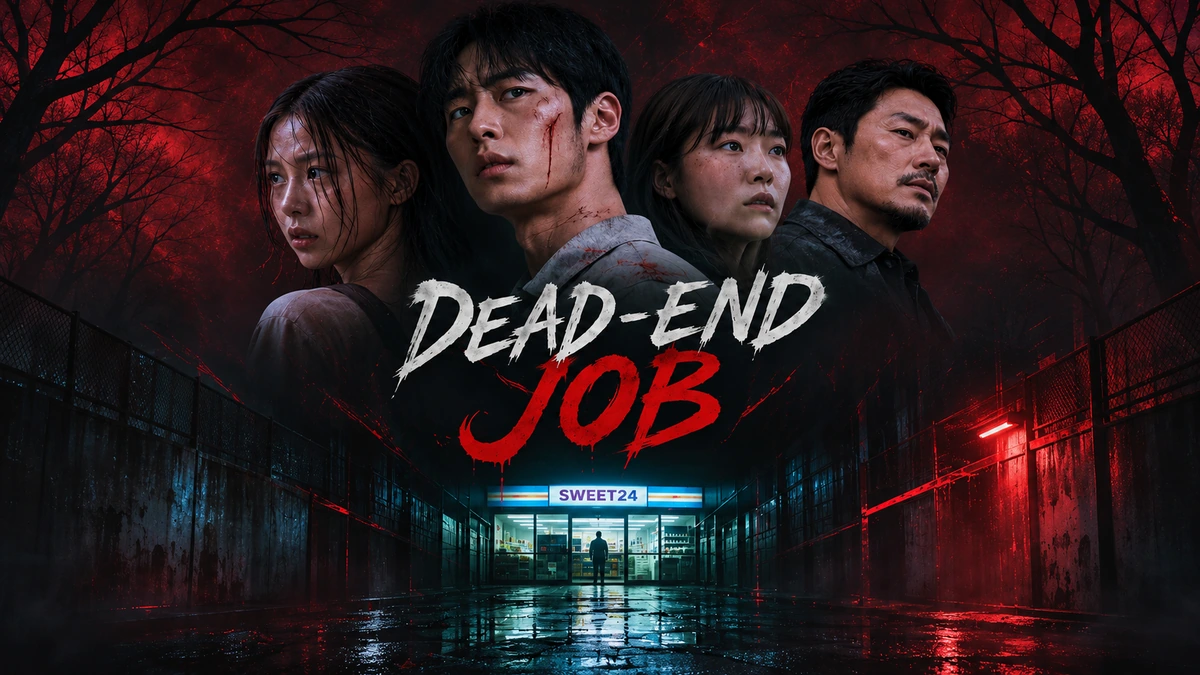
At first, it was simply a job he took to earn money. But as each new workplace became more dangerous and traces of missing workers began to emerge, the story moved in a far darker direction than expected.
By the final episode, the central question is no longer simply about who survives.
Is it ever acceptable to sacrifice someone else in order to survive?
This question connects the seemingly separate events throughout the series.
Netflix’s Dead-End Job is an eight-episode series released in October 2026. The currently available season concludes with Episode 8, titled “The Last Carnival.”
To understand its ending, it is important to distinguish between what the final episode actually reveals and what those events may mean.
Spoiler Warning: The following discussion contains major spoilers about the final episode, including important revelations and the ending.

Why a Young Man Desperate for Money Begins Searching for the Truth
Byeon Hyeok-jun never intended to uncover the secrets of Geomi Manpower.
He initially accepted its suspicious job offers because he was struggling with debt. What began as a dangerous shift at a convenience store gradually expanded into a series of increasingly disturbing assignments involving milk deliveries, clinical trials, construction sites, and other unusual workplaces.
But as Hyeok-jun continued working, he began to notice something troubling.
People who desperately needed money were being sent into dangerous environments, and some of them never returned.
The unusually high wages were not simply compensation for difficult work. They were payments offered in exchange for risking human lives.
The turning point came when Hyeok-jun began investigating the disappearance of his father, Byeon Min-su.
Like his son, Min-su had been trying to support his family when he became involved in the mysterious world connected to Geomi Manpower.
For Hyeok-jun, the final assignment was no longer about earning money.
He wanted to discover what had happened to his father and understand the system responsible for sending desperate workers into deadly situations.
The clues he discovered at the construction site in Episode 6 suggested that his father had disappeared through a doorway leading into another world.
This explains why Hyeok-jun voluntarily accepted a night parade assignment at Neoworld amusement park in Episode 7.
Even when the agency owner warned him that the job was unusually dangerous, Hyeok-jun refused to turn back.
Why Everyone Comes Together at Neoworld
The final episode takes place at Neoworld, an amusement park.
It is a place designed to entertain visitors, yet for the people working there, it becomes a workplace where survival itself is uncertain.
This contradiction brings the show’s central theme into sharper focus.
Hyeok-jun, his younger sister Ji-yun, the owner of Geomi Manpower, and Eum Yeon-ju all arrive at the same location for different reasons.
Hyeok-jun wants to find his father.
Ji-yun wants to save her brother.
The agency owner wants to prevent the boundary between two worlds from collapsing.
Yeon-ju, however, wants to open that boundary.
On the surface, the final episode presents a terrifying parade filled with supernatural danger.
But the real conflict is much deeper.
Should the doorway remain closed to preserve the existing world, or should it be opened even if doing so destroys the current order?
At this point, the story moves beyond the question of how to defeat supernatural creatures.
It becomes a conflict about who must pay the price for maintaining the world as it is.
The amusement park itself also carries symbolic meaning.
A place where visitors come to enjoy themselves is connected to a history of suffering among workers.
Behind its colorful present lies a past that has been forgotten or deliberately concealed.
In this sense, Neoworld is more than the setting of the final confrontation.
It is a place where the drama’s underlying message becomes visible.
The True Role of the Geomi Manpower Owner
Throughout the series, the owner of Geomi Manpower recruits people for suspicious jobs by offering unusually high wages.
At first, he appears to be a ruthless employment broker who knowingly sends workers into dangerous situations.
However, the explanation revealed near the end suggests that his role goes far beyond simply finding people for unusual jobs.
According to the owner, the human world and another world inhabited by supernatural beings exist close to one another.
When the boundary between them becomes unstable, strange incidents begin to occur.
Maintaining that boundary requires the intense life energy of living people.
Workers who are desperate enough to accept dangerous assignments are used for this purpose.
The owner presents these sacrifices as the necessary cost of preventing a much greater disaster.
His argument is that a small number of people must face danger so that the majority can remain safe.
What he is trying to protect is not the life of each individual worker, but the continued existence of the world as it currently operates.
However, even if the danger facing the world is real, that does not automatically justify his decisions.
The workers never agreed to confront supernatural creatures in order to save humanity.
They accepted employment because they needed money.
In many cases, they did not even understand the true extent of the danger.
This explains why Hyeok-jun rejects the owner’s reasoning.
The owner treats human sacrifices as numbers in a calculation.
Hyeok-jun, on the other hand, remembers the people who disappeared after working alongside him.
Someone who takes a job because they want to survive should never be treated as a disposable resource for someone else’s survival.
This difference forms the central moral conflict of the ending.
Why Eum Yeon-ju Wants to Open the Doorway
Eum Yeon-ju initially appears as an accident investigator from the Labor Accident Protection Agency.
At first, she seems to be someone who might help Hyeok-jun understand the dangerous situations surrounding him.
But the later episodes reveal that she is not an ordinary investigator belonging to the present day.
Yeon-ju was once a female worker at Gyeongil Textile around 40 years earlier.
She had been protesting against harsh working conditions when she encountered violence.
With the help of a fellow worker, she hid inside a locker.
However, the locker turned out to be a passage to another world.
When she finally emerged, many years had already passed.
The series does not fully explain exactly when or how Yeon-ju became connected to supernatural forces.
What matters is that her memories of unjust treatment at work and her anger toward society provide the key to understanding her actions in the final episode.
Yeon-ju believes that even though the era she once lived in has ended, the system that forces vulnerable people to bear the greatest risks has never truly changed.
Factories have been replaced by different workplaces.
Contracts and financial rewards may look different, but people with limited choices are still being sacrificed.
For Yeon-ju, opening the doorway between worlds is a way to destroy a society she sees as fundamentally unfair.
Yet experiencing injustice does not automatically make every act of revenge acceptable.
Opening the doorway could endanger people who had nothing to do with the suffering she experienced.
Yeon-ju hates a system that forces others to sacrifice themselves, but she is willing to place innocent people at risk in order to destroy it.
This makes her relationship with the agency owner especially interesting.
They appear to stand on opposite sides, yet their methods have a disturbing similarity.
The owner sacrifices vulnerable people to preserve the world, while Yeon-ju accepts further sacrifices in order to destroy it.
Despite their different goals, both treat other people’s lives as a means to achieve something larger.
What Happens When the Doorway Opens
During the final confrontation, the agency owner attempts to stop Yeon-ju.
Hyeok-jun, however, distrusts both the owner’s explanations and his actions.
He also believes that the answers about his missing father may lie beyond the mysterious doorway.
Despite the warnings, Hyeok-jun moves toward opening it.
When the doorway opens, darkness and supernatural beings from the other world begin pouring through.
Yeon-ju and the agency owner are swept into the darkness.
However, their disappearance should not automatically be interpreted as confirmation that they have died.
What the episode actually shows is that both characters disappear into the darkness beyond the doorway.
It would also be an oversimplification to describe Hyeok-jun’s actions as a deliberate attempt to destroy the world.
He desperately wants to find his father.
More importantly, he cannot accept the owner’s argument that sacrificing vulnerable workers is necessary.
At the same time, the series does not ignore the enormous danger created by his decision.
Hyeok-jun is not a perfect hero who understands every consequence of his actions.
Resisting an unjust system may be necessary, but destroying that system can also create consequences that demand responsibility.
The ending refuses to present either side as an easy or completely correct answer.
Why the Reunion With His Father Is So Tragic
After being pulled into the darkness beyond the doorway, Hyeok-jun finally encounters his father, Byeon Min-su.
But the long-awaited reunion is far from a happy family moment.
His father has been trapped in the other world for so long that he has almost lost the person he once was.
One of the most heartbreaking details is the money he still holds, apparently intending to give it to his family.
Even after so many years, Min-su seems unable to escape the belief that he must continue earning money for the people he loves.
The contrast between his inability to fully recognize his son and his continued attempt to offer money makes the scene especially tragic.
The work he began in order to support his family ultimately took away his chance to return to them.
That single idea captures the tragedy of his fate.
His desire to provide for his family remains, but the everyday life and relationships that gave that desire meaning have disappeared.
Hyeok-jun has been following a dangerously similar path.
He repeatedly accepted life-threatening jobs because he wanted to repay his debts and protect his family.
In that sense, his father represents more than a tragedy from the past.
He also represents a possible future that Hyeok-jun might have faced.
Although Hyeok-jun finally discovers what happened to his father, he cannot bring him back to the ordinary world.
Finding an explanation for someone’s disappearance does not erase the pain of losing them.
Some years and relationships cannot be restored, no matter how much money is involved or how extraordinary the circumstances become.
That is what makes their reunion so emotionally powerful.
The Meaning of Ji-yun Saving Her Brother
When Hyeok-jun is being pulled deeper into the darkness, it is his younger sister Ji-yun who helps bring him back.
The siblings work together to close the doorway between the two worlds and prevent the disaster from spreading further.
Their father does not return, but the brother and sister refuse to abandon one another.
This moment creates an important contrast with the decisions made by the other major characters.
Geomi Manpower’s system transfers danger onto other people.
Yeon-ju is willing to place others in danger in pursuit of her anger and revenge.
Ji-yun, however, focuses on saving the person directly in front of her.
Rather than relying on a grand justification about saving the world, her actions demonstrate the importance of protecting an individual human life.
That is why the rescue scene carries so much meaning.
Closing the doorway does not necessarily mean every supernatural danger has disappeared.
But the siblings demonstrate that they may be able to avoid repeating their father’s tragedy.
Hyeok-jun once tried to carry the burden of debt alone, repeatedly accepting dangerous jobs without asking for help.
Now, he has a family member who is willing to face those difficulties alongside him.
Why the Story Is Not Over Even After Life Returns to Normal
After the incident, Hyeok-jun settles his debts and returns to ordinary part-time work.
On the surface, his circumstances have improved.
He also seems to appreciate time with his family more deeply than before.
Another meaningful moment comes when he encounters a woman on a bridge who appears ready to end her life.
Earlier in the story, Hyeok-jun himself had been overwhelmed by despair at the same location.
Now, instead of giving in to hopelessness, he tries to offer another person a reason to keep living.
This change does not happen because he becomes rich or gains extraordinary powers.
It happens because he transforms his own experience of suffering into a reason to help someone else survive.
However, reports of unexplained fires and unusual incidents continue to appear in the news.
Although the siblings managed to close the doorway, the problems connecting the two worlds do not appear to have been completely resolved.
Stopping an immediate disaster and eliminating the underlying cause are two different things.
For that reason, the ending of Dead-End Job is not a conventional happy ending.
The family survives and ordinary life continues, but the system that places vulnerable people in dangerous situations still exists.
The Offer to Become the New Head of Geomi Manpower
One of the most meaningful twists comes after the main crisis appears to have ended.
Hyeok-jun receives a message from Geomi Manpower and returns to its abandoned office.
There, he discovers a recorded message left by the former owner.
This time, the offer is not another temporary job.
He is being asked to take over the organization and become its new manager.
The person who had repeatedly been sent into dangerous workplaces is now being offered the position of deciding where other people will be sent.
The former owner asks whether Hyeok-jun might be capable of making different choices.
Just as Hyeok-jun is about to respond, the screen cuts away.
The audience never hears whether he accepts or rejects the offer.
The final mystery is not simply whether the former owner survived. It is what kind of manager Hyeok-jun might become.
Accepting the position would not automatically mean that Hyeok-jun would become the same kind of person as his predecessor.
He might attempt to change the organization from within and find a way to reduce the suffering of its workers.
On the other hand, he might eventually repeat the owner’s logic, convincing himself that some sacrifices are unavoidable if the world is to survive.
The drama does not confirm either possibility.
What makes this situation particularly disturbing is that the real problem may not be the cruelty of one individual.
Instead, it may be a system that continues operating even after the person in charge disappears.
The former owner may be gone, but the position he occupied still exists.
If the underlying rules remain unchanged, the same tragedies could happen again.
The Meaning of Ji-yun’s Acceptance Message From Gyeongil Group
A short scene during the ending credits introduces another important detail.
Ji-yun receives a message informing her that she has been accepted for a position at Gyeongil Group.
The company name recalls Gyeongil Textile, where Yeon-ju once worked, as well as the corporate connections surrounding the amusement park.
Hyeok-jun receives an offer to manage Geomi Manpower.
Meanwhile, Ji-yun receives an employment offer from a company whose name is connected to the history revealed earlier in the series.
The siblings appear to have escaped the world of dangerous labor, only to find themselves standing before two different entrances that may lead back into it.
However, the series does not definitively establish that Gyeongil Group controls or directly manages Geomi Manpower.
The connection between the names raises suspicions, but the precise relationship between the organizations remains open to interpretation.
This scene should not automatically be treated as confirmation of another season.
Its more immediate significance lies in the suggestion that danger does not exist only in supernatural workplaces.
It can also return through ordinary recruitment procedures, corporate organizations, and seemingly promising employment opportunities.
By the end, even the idea of receiving a successful job application feels strangely unsettling.
Whose Choice Is the Ending Really Asking Us to Consider?
Ultimately, Dead-End Job asks viewers to think about human dignity rather than wages.
The workers agreed to take jobs because they needed money.
They did not agree to give up their right to live.
The owner of Geomi Manpower treated their sacrifices as a necessary cost of preserving the world.
Yeon-ju believed that the world responsible for such suffering deserved to be destroyed.
Caught between these opposing beliefs, Hyeok-jun has not yet found a complete answer.
But he possesses an experience that neither argument can easily dismiss.
He has personally stood among the people being sacrificed.
He has watched coworkers disappear.
He has also discovered what happened to his father after years of exploitation and suffering.
The final question is what he will do with that knowledge.
If Hyeok-jun refuses the offer from Geomi Manpower, he may be able to walk away from the organization.
But the system could simply find someone else to replace him.
If he accepts the position, he might gain the opportunity to change things from within.
At the same time, he could eventually find himself forced to make the same decisions he once condemned.
Neither choice offers an easy solution.
That is why the silence at the end can be understood as an open ending that places responsibility for the final decision in the viewer’s hands.
If the world can only continue by sacrificing certain people, what rules should be changed?
And if we were given the power to change those rules, would we actually make different decisions?
Netflix currently identifies the drama as a limited series, and as of November 9, 2026, no official confirmation of another season has been established.
The final message can therefore be interpreted as a clue suggesting possible future events, but it should not be treated as proof that a sequel has already been confirmed.
In the end, Dead-End Job suggests that the greatest horror is not the monsters waiting beyond the doorway.
It is the workplace system that remains even after that doorway has been closed.
A battle against supernatural creatures may eventually come to an end.
But changing a system that treats human beings as disposable resources is a much longer and more difficult struggle.
Perhaps that is why the series never allows us to hear Hyeok-jun’s final answer.
The question he faces is one that nobody can answer easily.